Mac Grove Painting has worked across the Twin Cities long enough to know that Brooklyn Center’s housing stock tells a specific and consistent story: block after block of post-war ramblers built during the late 1950s and 1960s, low-slung and practical, the kind of homes that defined suburban expansion in Hennepin County after World War II. That uniformity isn’t a limitation — it’s useful. We arrive on these jobs already familiar with what we’re likely to find: aluminum siding that’s been through decades of Minnesota freeze-thaw cycles, aging caulk around windows and trim, and north-facing walls that stay damp long enough to encourage mildew if the wrong coatings go on.
The majority of single-family homes here were built before 1970, and the exterior materials reflect that era. Aluminum siding, brick veneer, and stucco are common across the city’s ranch-style footprints. Each requires a different preparation approach. Aluminum needs cleaning, light scuffing, and a primer that bonds to bare metal where old paint has chalked or flaked. Stucco demands careful crack repair before any coating goes on, and brick — depending on its condition and the homeowner’s goals — may call for a breathable masonry paint or a clear sealer rather than a pigmented finish. Getting the prep right on these older materials is what separates a paint job that lasts from one that starts failing within a few seasons.
Climate and Geography Shape Every Exterior Project Here
Brooklyn Center sits on relatively flat terrain with fewer mature trees than some older Minneapolis neighborhoods, which works in a painter’s favor during the warmer months — surfaces dry faster and more evenly under consistent sun exposure. That said, the city’s proximity to the Mississippi River on its eastern edge creates pockets of higher humidity, and shaded north-facing walls on ramblers can retain moisture long after south-facing surfaces have dried out. We factor this into product selection: mildew-resistant exterior formulations are standard practice on these exposures, not an upgrade.
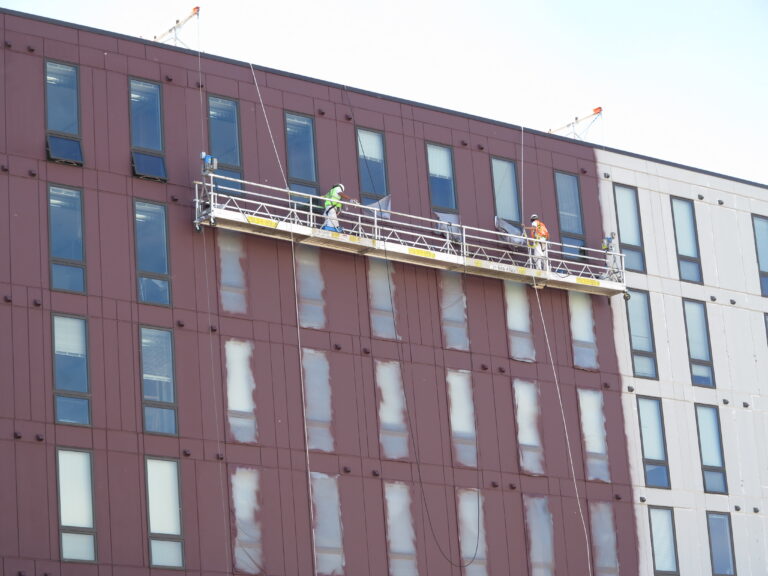
The Earle Brown Farm area — the 1926 agricultural complex now integrated into the Lux Apartments development — is one of the more architecturally layered parts of Brooklyn Center, where historic masonry sits alongside newer construction. It’s a good illustration of how the city has layered decades of building on top of one another without straying far from its low-profile, practical character. Whether a project involves a mid-century rambler on a quiet residential street or a multifamily building from the 1960s or 1970s, the work tends to reward painters who understand how these structures age and what they need.
Interior painting in Brooklyn Center follows a similar pattern. These are honest, functional homes — many with original trim, hardwood floors, and layouts that haven’t changed much since they were built. Careful masking, clean lines, and color choices that work with natural light from the era’s characteristically horizontal windows matter more here than any particular trend. We take that seriously on every job we do in the city, the same way we do throughout the rest of the metro.